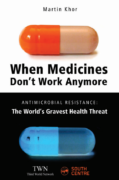
Antibiotic resistance, now widened to be called antimicrobial resistance, is the world’s greatest public health risk and threat. We are now so used to using antibiotics that it is almost unthinkable what would happen to our state of health if there were none available. Or if the antibiotics don’t work anymore.
Health leaders are sounding the alarm bell. The Chief Medical Officer of the United Kingdom has warned of a looming “catastrophe” so widespread that we would be back to a pre-antibiotic era when many diseases could not be treated. The World Health Organisation’s then Director General has said the world is heading towards a post-antibiotics era in which common infections such as strep throat or a child’s scratched knee could once again kill. It may even bring the end of modern medicine. And heads of states and governments in 2016 adopted a landmark Political Declaration recognising that antibiotic resistance is the “greatest and most urgent global risk”.
This book is a collection of articles written over two decades, tracing the antimicrobial resistance problem as it evolved through the years into a full blown crisis. It also contains the author’s speaking notes at the UN General Assembly summit-level special event on AMR. It provides news and opinions in popular language on various aspects of AMR, as the problem emerged and then developed into the present day public health catastrophe.
Author: Martin Khor is the Executive Director of the South Centre.
Climate Partnerships for a Sustainable Future: An initial overview of South-South cooperation on climate change in the context of sustainable development and efforts to eradicate poverty
At COP23, the United Nations Southern Climate Partnership Incubator (SCPI) released a report entitled “Climate Partnerships for a Sustainable Future: An initial overview of South-South cooperation on Climate Change in the context of sustainable development and efforts to eradicate poverty”. This report was jointly produced by the South Centre and the UN Office for South-South Cooperation (UNOSSC).
South Centre Statement at the 27th Session of the World Intellectual Property Organization (WIPO) Standing Committee on the Law of Patents
As this year’s work in the WIPO substantive committees will end with the conclusion of the 27th session of the Standing Committee on the Law of Patents (SCP), we are reminded that next year will mark the tenth anniversary since the SCP had reconvened in 2008 with a focus on developing a balanced work programme on issues relating to the law of patents to also address development and public policy questions that arise in the context of the patent system. The work of the SCP, in this sense, is integral to advancing the WIPO Development Agenda.
As global health leaders warn that antibiotic resistance is leading to the end of modern medicine, the World Health Organization (WHO) issues guidelines to prohibit or restrict using antibiotics to feed animals reared for their meat. Urgent coordinated actions are needed to avoid the end of modern medicine. The author Martin Khor is the Executive Director of the South Centre. This article was also published by Inter Press Service (IPS) (more…)
This update provides a snapshot of the activities of the Development, Innovation and Intellectual Property Programme during the month of November 2017.
China’s Debt Problem and Rising Systemic Risks: Impact of the global financial crisis and structural problems
The fast expansion of China’s debt, in particular corporate and local government debt, has attracted international attention and has also become a major concern of China’s policy makers. Even though China can tolerate a higher debt level than many other emerging and developing economies owing to the sheer size and other special features of the Chinese economy, systemic risks for financial stability have been rising since the global financial crisis and the cushions built in the past decades to withstand a higher debt level have also been weakened. (more…)
South Centre Statement for the UNCTAD Intergovernmental Group of Experts on Financing for Development
Below is the statement by the South Centre during the first session of the UNCTAD Intergovernmental Group of Experts on Financing for Development (IGE Ffd) held in Geneva on 8-10 November 2017.





 About the Book: