Health Equity
South Centre Annual Report 2025
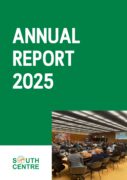
The South Centre carries out multiple activities to support developing countries with policy-oriented research, inputs and advice for negotiations and capacity building. The Report summarizes the South Centre’s activities in 2025 and highlights the contexts in which they were conducted as well as the objectives that were pursued with their implementation.
(more…)
UN Human Rights Council Resolutions on Access to Medicines and the Use of TRIPS Flexibilities: A Review
By Nirmalya Syam
This paper reviews almost twenty years of the United Nations Human Rights Council’s (UNHRC) work on access to medicines. The UNHRC has repeatedly framed access to medicines as part of the right to health and has urged States to rely on flexibilities in the Agreement on Trade Related Aspects of Intellectual Property Rights (TRIPS) to make essential treatments more affordable. Although the UNHRC has strengthened the human rights foundation for using such flexibilities, its resolutions have produced little change on the ground. The commitments embodied in the UNHRC resolutions stay broad and non-binding, leaving the deep structural barriers in place, including restrictive intellectual property (IP) clauses in trade deals, pressure from powerful States, limited technical and manufacturing capacity, and weak policy coordination within governments. Moreover, several recent resolutions reaffirm the value of IP protection, which creates tension that dilutes the Council’s support for the wider use of TRIPS flexibilities. The paper finds that the main gap between global human rights commitments and national action on advancing access to medicines reflects political choices and structural barriers, and concludes by calling for stronger mandates for States to review access barriers during the Universal Periodic Review, increased technical assistance from the Office of the High Commissioner for Human Rights, more civil society participation, national right-to-health action plans, and systematic monitoring of TRIPS implementation.
(more…)
Health Equity in Global Governance: growing recognition in need of concrete actions
By Carlos M. Correa
Health equity is a foundational principle of global health governance that should ensure all individuals have fair and just opportunities to achieve optimal health, regardless of social, economic, or geographical disparities. The right to health is recognized as a fundamental human right in Article 12 of the International Covenant on Economic, Social and Cultural Rights (ICESCR). This document explores the concept of health equity drawing on United Nations General Assembly (UNGA) resolutions and key instruments from the World Health Organization (WHO). It discusses the challenges and opportunities for developing countries in pursuing equitable health outcomes, including advancing sexual and reproductive health and rights.
(more…)
Experiences and Challenges Faced by Sri Lanka in Implementing the Highest Attainable Standard of Health, Including Health Equity and Sexual and Reproductive Health and Rights
By Janani Sivapakthan
Sri Lanka’s long-standing commitment to free and equitable healthcare with a focus on primary healthcare has yielded impressive achievements in health equity, maternal and child health, disease elimination, and sexual and reproductive health and rights. However, Sri Lanka faces challenges in upholding health equity in the context of escalating domestic and global pressures. Safeguarding the highest attainable standard of health for all Sri Lankans requires addressing underinvestment, workforce migration, uneven service distribution, and the emerging burden of non-communicable diseases in a context of economic constraint.
(more…)
Promoting Health Equity and Reproductive Rights in Angola
By Sandra Benge Neto
This article examines Angola´s progress in rebuilding its health system in the post conflict era, focusing on health equity and the promotion of Sexual and Reproductive Health and Rights (SRHR) in alignment with the Protocol to the African Charter on Human and Peoples’ Rights on the Rights of Women in Africa (Maputo Protocol) and international human rights commitments.
Despite significant advances – such as the expansion of primary healthcare, municipalization of services, and youth–friendly centres – Angola continues to face challenges including geographic disparities, sociocultural barriers to contraception, insufficient funding, and limited data systems. Drawing from national initiatives and community based experiences, this article highlights best practices and strategic recommendations to accelerate Angola´s implementation of the Maputo Protocol and achieve universal, gender–responsive health coverage.
(more…)
Independent Panel on Evidence for Action against Antimicrobial Resistance (IPEA): Reflections on the Foundational Documents
By Dr. Viviana Munoz Tellez
The United Nations General Assembly (UNGA) invited the Quadripartite Organizations to establish an Independent Panel on Evidence for Action against Antimicrobial Resistance (IPEA) in 2025. The launch of the IPEA is planned for 10 December 2025 during the United Nations Environment Assembly (UNEA). The Quadripartite organizations (the Food and Agriculture Organization (FAO), the United Nations Environment Programme (UNEP), the World Health Organization (WHO) and the World Organisation for Animal Health (WOAH)) released in November 2025 updated draft documents for the IPEA for additional consultation with Member States and stakeholders. The IPEA will constitute a welcome addition to global Antimicrobial Resistance (AMR) governance, and should be established, starting small and building gradually. Several concerns on the proposed model remain concerning the governance structure, equity in participation, and the independence of the panel. This policy brief provides analysis and recommendations on key issues concerning the draft foundational documents for the IPEA requiring attention.
(more…)
ID with the SR on the right of everyone to the enjoyment of the highest attainable standard of physical and mental health
South Centre Statement (Item 3)
In its 59th session of the Human Rights Council statement on the Right to Health, the South Centre addressed the Special Rapporteur’s report, focusing on the protection of health and care workers. The statement noted the challenges they face, from migration impacts to poor working conditions, and called for their protection to ensure health equity for all.
(more…)
Upholding health equity:
Access to medical products and reproductive rights
Side Event to the 59th Session of the Human Rights Council
23 June 2025
12:00 to 13:00
Room XXVII, Palais de Nations, Geneva, Switzerland
The pursuit of health equity, encompassing fair and just opportunities for all to achieve their full health potential, remains a paramount global challenge. The right to health is a fundamental part of our human rights and of our understanding of a life in dignity. This event will explore the indivisible links between equitable access to medical products, the advancement of sexual and reproductive health and rights (SRHR), and the strengthening of international cooperation as pillars for upholding this fundamental right for everyone, everywhere. The interconnectedness of these themes is central; they are not disparate issues but integral components of a holistic approach necessary to realise comprehensive health equity.
The side event is anticipated to significantly enhance participants’ understanding of the complex, intersecting challenges and opportunities in upholding health equity, particularly through improved access to medical products and the full realization of SRHR. The discussions aim to identify potential policy pathways, innovative approaches, and actionable strategies for key stakeholders to address existing inequities. Furthermore, a crucial outcome will be a reinforced commitment to multilateralism and collaborative action as essential tools for tackling global health challenges and advancing the right to health, with the dialogue contributing valuable insights to ongoing policy debates in relevant international fora, especially concerning the implementation of recent global agreements and agendas, while also strengthening networks and partnerships dedicated to health equity and human rights.
(more…)
INTERNSHIP PROGRAMME – STRENGTHENING THE RIGHT TO HEALTH
The South Centre is seeking to fill internship positions to support its activities in the area of strengthening the right to health from a perspective of countries of the Global South.
Specific intern responsibilities include, but are not limited to, supporting the Strengthening the Right to Health project.
The deadline for applications is 2 June 2025.
(more…)
Webinar Report:
Advancing Antimicrobial Stewardship Policies: Lessons from the COVID-19 Pandemic and Priorities for Future Health Emergencies
By Dr Rasha Abdelsalam Elshenawy
Our recent South Centre webinar examined how the pandemic created a dual challenge for global health:
– MISUSE: 35-75% of hospitalized COVID-19 patients received antibiotics despite low bacterial co-infection rates.
– ACCESS BARRIERS: The pandemic disrupted supply chains and healthcare access, limiting antimicrobial availability in many regions.
This paradox—overuse alongside access challenges—must inform future pandemic preparedness.
Our experts call for:
– Integrating antimicrobial stewardship into emergency response
– AMS frameworks must be established BEFORE health emergencies
– Strengthening surveillance systems and diagnostic capacity
– Ensuring sustainable and equitable access to antimicrobials
(more…)
South Centre Statement to the Resumed Thirteenth Meeting of the Intergovernmental Negotiating Body to Draft and Negotiate a WHO Convention, Agreement or Other International Instrument of Pandemic Prevention, Preparedness and Response
7 April 2025
Negotiations resume for a WHO pandemic agreement, aiming to finalise the text in 5 days. Will Member States show the needed leadership and will to deliver an impactful outcome with equity at the core?
(more…)
Strengthening Antimicrobial Stewardship Policy: Insights from COVID-19 and Future Pandemic Preparedness
South Centre Webinar
Date: 14 April 2025
Time: 12:00 PM – 1:00 PM CEST | 6:00 AM – 7:00 AM EDT | 3:30 PM – 4:30 PM IST
Location: Virtual (Zoom)
In this one-hour webinar, we will explore how the COVID-19 pandemic impacted antimicrobial stewardship (AMS) programmes and what lessons can strengthen future pandemic preparedness, especially in low- and middle-income countries (LMICs).
(more…)