A Regional Tax Cooperation Initiative Under the ECOWAS Framework
The South Centre is supporting two of its Member States, Liberia and Sierra Leone, in implementing a pilot Simultaneous Tax Examination on Multinational Enterprises (MNEs), in partnership with the Economic Community of West African States (ECOWAS) Commission. The pilot, which can generate potentially substantial tax revenues, will operationalize the ECOWAS Supplementary Act on Mutual Administrative Assistance in Tax Matters. The pioneering pilot, potentially the first of its kind in the Global South, will develop audit capacity, generate domestic revenue, and build a model that can be scaled across other Member States of the South Centre and ECOWAS.
Read more in the press release jointly issued with ECOWAS and the governments of Liberia and Sierra Leone (également disponible en français/também disponível em português):
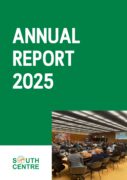
The South Centre carries out multiple activities to support developing countries with policy-oriented research, inputs and advice for negotiations and capacity building. The Report summarizes the South Centre’s activities in 2025 and highlights the contexts in which they were conducted as well as the objectives that were pursued with their implementation.
South Centre Inputs to the Intergovernmental Negotiating Committee on the UN Framework Convention on International Tax Cooperation
The Intergovernmental Negotiating Committee (INC) on the United Nations Framework Convention on International Tax Cooperation (UNFCITC) released three documents in January 2026 to inform negotiations at its Fourth Session, held in February 2026 in New York:
Co-Leads’ Concept Note (23 Jan 2026) prepared by Workstream III, presenting potential design features for dispute prevention and resolution protocol mechanisms.
The South Centre submitted inputs on the three documents on February 26 and March 6, 2026, following a call for input by the INC. The submissions are reproduced below:
OECD Two Pillar Solution: Designed to Prevent the Offshoring of High Tech Production to the Global South
By Abdul Muheet Chowdhary
The Organisation for Economic Co-operation and Development (OECD) Two Pillar solution is a tool of the developed countries designed to: a) prevent Multinational Enterprises (MNEs) in frontier technologies like clean energy, computing, semiconductors, etc. from offshoring production to developing countries, and b) minimize Global North MNEs’ taxable profits in developing countries. The recent exemption of the United States’ MNEs from certain aspects of the OECD Global Minimum Tax further strengthens these objectives. South Centre Member States and other developing countries should resist pressures to adopt the Two Pillar solution and make informed, evidence-based decisions, while considering the benefits of other simpler and more beneficial alternatives.
Taxation of digital services – A Domestic Law Solution for Overcoming Tax Treaty Barriers
By Radhakishan Rawal
Tax treaty treatment of source taxation of cross-border services continues to be an unresolved issue even fifteen years after it was recognized as a major issue within the Base Erosion and Profit Shifting (BEPS) Project. While the Organisation for Economic Co-operation and Development (OECD) Inclusive Framework’s Amount A of Pillar One does not seem to be getting finalised, at the United Nations (UN) an Intergovernmental Negotiating Committee (INC) is working on a UN Framework Convention on International Tax Cooperation which will offer a solution to the issue. The success of the UN’s initiative will depend on how many developed countries sign the Framework Convention and relevant Protocols.
This article evaluates a Domestic Law Solution to the issue which was presented at the February 2026 session of INC at New York. As per this solution, the domestic law of the source country can define the term “profits of an enterprise” to exclude consideration for digital services and thus bypass treaty restrictions on source taxation. As a result of this, the source country will be able to levy tax on such income in terms of Article 21(3) of the tax treaties signed by it provided the wording of Article 21(3) is identical to that in the UN Model Tax Convention.
The South Centre has made a submission to the Intergovernmental Negotiating Committee of the United Nations Framework Convention on International Tax Cooperation on the draft Framework Convention’s commitments, and Dispute Prevention and Resolution protocol.
The contribution addresses the priorities and perspectives of developing countries in promoting inclusiveness, fair allocation of taxing rights, stronger transparency standards, and effective and accessible dispute prevention and resolution mechanisms.
Digital businesses continue to grow and generate substantial revenue in market jurisdictions without maintaining a physical presence. They mainly rely on intangibles, user data and user engagement. International tax rules have not kept pace with these developments, leaving many jurisdictions unable to tax digital economic activity effectively. In response, countries have introduced national measures, such as Digital Services Taxes (DSTs), equalisation levies, and Significant Economic Presence (SEP) taxes, while continuing to engage in multilateral efforts. This paper examines how countries have implemented such measures. The study applies structured case studies of Colombia, India, Kenya, Nepal, Nigeria, and Tanzania. It analyzes the countries’ legal frameworks, administrative practices, and revenue outcomes, while also identifying shared features and key differences in implementation approaches. The paper explores the conceptual foundations and theoretical justifications for taxing digital revenues at source, highlighting the limitations of current profit allocation rules that overlook the role of the market. Drawing from these country experiences, the study develops a peer learning framework based on emerging best practices while recognizing the challenges in implementation. The study then proposes pathways for harmonizing digital tax measures and outlines essential design elements to inform the development of the early protocol on the taxation of cross border services (which includes digital services) under the United Nations Framework Convention on International Tax Cooperation.
Future of the UN Tax Committee under the UN Framework Convention on International Tax Cooperation
By Aisha Aize Isa, Sabrine Marsit, Abiodun Adewale Adegboye, Nyatefe Wolali Dotsevi, Anne Wanyagathi Maina and Abdul Muheet Chowdhary
The global tax governance landscape has recently undergone major shifts and is now at a pivotal momentum where demands of inclusivity, transparency and an equitable tax system are increasingly growing amongst countries. Central to this pivotal momentum is the creation of the United Nations Framework Convention on International Tax Cooperation (UNFCITC), mandated by United Nations (UN) General Assembly Resolution 78/230 (December 2023). The UNFCITC’s objective is to establish an intergovernmental platform for governance and cooperation in international taxation. This report aims at exploring the possible role of the UN Committee of Experts on International Cooperation in Tax Matters (UNTC) within the merging architecture of the UNFCITC, drawing on past lessons of efforts to democratize international tax governance.
South Centre Inputs on 2025-2029 Work Program of the UN Tax Committee
25 September 2025
The United Nations (UN) Secretary-General appointed a new Membership of the UN Tax Committee to hold office from 2025-2029. This includes Members nominated by Brazil, Cambodia, Dominican Republic, India, Jamaica, Liberia, Nigeria and Sierra Leone (all of them are members States of the South Centre). The Committee will hold its first meeting in October in Geneva, Switzerland, and will decide, among other things, the issues they should work on during the tenure of the new members. The Committee also issued a call for inputs to stakeholders to help shape this agenda.
To ensure that the four-year agenda contains topics of importance to South Centre Member States and developing countries more generally, the South Centre made a submission to the Committee which is reproduced below.
Country-Level Revenue Estimates – A Comparative Analysis of UN and OECD Subject to Tax Rules for 65 Member States of the G-24 and South Centre
Washington and Geneva, 23 July 2025
The South Centre & Group of Twenty-four today jointly released country-level revenue estimates of the UN & OECD Subject to Tax Rule (STTR) for their 65 combined Member States.
Results show higher revenues from UN STTR, and reinforce benefits of a UN Tax Convention.
Comparison of Tax Revenue Effects of United Nations and OECD Subject to Tax Rule for G-24 and South Centre Member States
By Faith Amaro and Sol Picciotto
The Subject to Tax Rule (STTR) seeks to address the historical imbalance in the allocation of taxing rights under international tax treaties by introducing within existing treaties a new article which makes the restrictions on source taxation conditional on the residence jurisdiction imposing a minimum level of tax on foreign-derived income. This paper presents a methodology for analysing the respective benefits of the STTRs developed by the Organisation of Economic Co-operation and Development (OECD) and the United Nations (UN). Applying this model to publicly available data for 2021, it also provides estimates of the possible revenue impact for the 65 Member States of the South Centre (SC) and the Intergovernmental Group of 24 (G-24). Our analysis indicates that the OECD STTR would have no impact on any OECD country treaty with a SC/G-24 Member State. Applying the prescribed 9% minimum rate to covered payments, only 100 treaties across 28 SC/G-24 Member States would qualify for improvement under the OECD STTR, with an estimated combined revenue gain of USD 55.6 million, 71% of which is concentrated in just five treaties. In contrast, the UN STTR, which does not specify a minimum rate, was modelled using rates of 9%, 10% and 15%. This resulted in estimated revenue gains of USD 212 million, USD 325 million, and USD 1,165 million across 171, 210 and 317 treaties, respectively. Given its complexity and restrictive scope, it seems pointless for any SC/G-24 Member State to join the OECD STTR. Instead, countries should focus on identifying treaties that cause unjustifiable revenue losses and consider revising them – either by adopting the simpler and broader UN STTR or implementing other measures such as active anti-abuse provisions to combat treaty shopping and tax avoidance.
Analysing the Impact of UN and OECD Subject to Tax Rule for G-24 and South Centre Member States
By Suranjali Tandon and Chetan Rao
The Subject to Tax Rule (STTR) is meant to address base erosion and profit shifting in cross –border transactions. The United Nations (UN) and Organisation for Economic Co-operation and Development (OECD)/Group of Twenty (G20) Inclusive Framework have developed models of the STTR that countries may choose to adopt in their treaties. This paper provides a review of these designs of two STTR models and proceeds to estimate the revenue gains for the Intergovernmental Group of Twenty-Four on International Monetary Affairs and Development (G-24) and South Centre Member States that may arise from a STTR that covers different kinds of payments. The OECD STTR is limited to related-party payments and imposes thresholds based on mark-up and materiality, reducing its applicability in practice. In contrast, the UN STTR offers broader coverage, applies to both related and unrelated parties, and does not impose restrictive thresholds, making it more administratively feasible for developing countries. Although the estimated gains from the OECD STTR appear modest due to its narrow scope, the UN STTR shows greater potential. The analysis also highlights data limitations and the need for access to microdata for accurate country-level assessments.