South Centre Statement to the Ministerial Meeting of the Group of 24
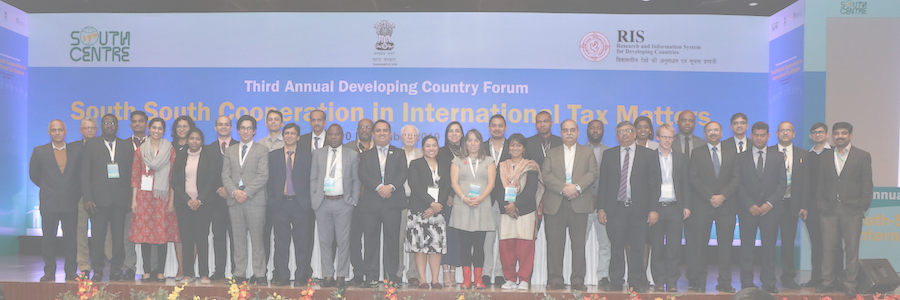
Below is the Statement by the South Centre’s Executive Director Mr. Martin Khor which was distributed during the Ministerial Meeting of the Group of Twenty-four held in Washington DC on 20 April 2017.
The failure of exceptional monetary measures pursued in response to the financial crisis in advanced economies to achieve a strong recovery has created a widespread concern that these economies suffer from a chronic demand gap and face the prospect of stagnation. This paper reviews and discusses the alternative views on the causes of the slowdown in accumulation and growth and the policies implemented and proposed to deal with it. (more…)
On the Existence of Systemic Issues and their Policy Implications
Systemic issues are issues that arise from the built-in features of the global system and the impact of the interaction of its parts; as implied in the chapter title in the Monterrey Consensus, it pertains to the coherence and consistency of the monetary, finance and trade systems. Systemic issues point at the weak points in the whole global financial “architecture,” the international structures and mechanisms that are beyond the control of individual countries. Systemic issues are a particular concern to developing countries, which have experienced their greatest development reversals during international payments crises. (more…)
Shocks for developing countries from President Trump’s first days
By Martin Khor
His first days in office indicate that President Donald Trump intends to implement what he promised, with serious consequences for the future of the United Nations, trade, the environment and international cooperation, and developing countries will be most affected. Those who hoped Trump would be more statesman-like in style and middle-of-the-road in policy matters after his inauguration had their illusions dashed when the new United States President moved straight into action to fulfil his election pledges. (more…)
2017 — a thunderous clash of politics, economies and policies
By Martin Khor
Yet another new year has dawned. But 2017 will be a year like no other. There will be a thunderous clash of policies, economies and politics worldwide. We will therefore be on a roller-coaster ride, and we should prepare for it and not only be spectators on the side-lines in danger of being swept away by the waves. (more…)
Initial Global Effects of Trump Even Before Taking Office
By Martin Khor
Even before taking office, President-Elect Donald Trump and the policies he promised during his campaign are already having a worldwide impact in at least three areas — global finance, trade and climate change. If his election is described as an earthquake, the aftershocks are now being felt. Global funds are starting to move out of many developing countries, reducing the value of their currencies and causing great economic uncertainty. (more…)
Global debt has jumped alarmingly to US$152 trillion and as capital flows out from developing countries, some facing new debt crises. Debt worldwide has grown to unprecedentedly high levels and has to be brought down to prevent another financial crisis. This was highlighted by the International Monetary Fund at its annual meeting in Washington earlier this month.
The EPA issue has once again re-emerged when Tanzania informed EAC Members and the EU that it would not be able to sign the Economic Partnership Agreement (EPA) between EU and the six EAC Member States in early July. The European Commission reportedly proposed signature of the EAC EPA in Nairobi, on the sidelines of the 14th session of the UN Conference on Trade and Development (UNCTAD XIV). (more…)
Debt Dynamics in China – Serious problems but an imminent crisis is unlikely
Recently, there have been many articles in the international media predicting that China is facing an imminent financial/debt crisis worse than the 2008 US sub-prime crash. However, a closer look at the debt dynamics in China highlights some fundamental differences be-tween the debt situation of the source country of the 2008 global financial crisis and that of China. (more…)
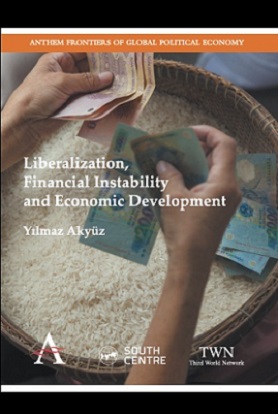
Liberalization, Financial Instability and Economic Development
About the book: Weighing up the costs and benefits of economic interdependence in a finance-driven world, this book argues that globalization, understood and promoted as absolute freedom for all forms of capital, has been oversold to the Global South, and that the South should be as selective about globalization as the North. The book challenges the orthodoxy on the link between financial deepening and economic growth, as well as that between the efficiency of financial markets and the benefits of liberalization. Ultimately, the author urges developing countries to control capital flows and asset bubbles, preventing financial fragility and crises, and recommends regional policy options for managing capital flows and exchange rates.
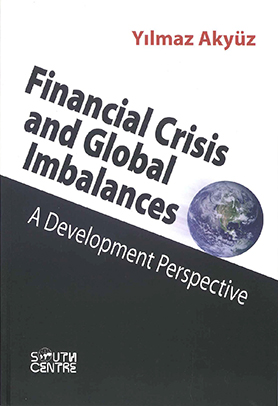
Financial Crisis and Global Imbalances: A Development Perspective
About the book: This book examines – from a standpoint of promoting stability and growth in developing countries – key policy lessons to be drawn from the devastating global economic crisis of 2008-09. In this collection of papers on the 2008-09 Great Recession and its implications, leading economist Yılmaz Akyüz underlines the need for economic restructuring along the above lines with a view to more effective crisis prevention and intervention. Given their vulnerability to shocks and limited capacity to respond, he says, this reform process is an endeavor in which developing economies have a crucial interest.
World Economic Situation: Serious Difficulties Call For Bold Measures
Dr. Yılmaz Akyüz, Chief Economist of the intergovernmental organization South Centre, says that the 2008 financial crisis may be moving in a third wave that could devastate the Global South. (more…)