This policy brief provides an overview of the outcomes of selected agenda items that were discussed at the 72nd session of the World Health Assembly (WHA) of the World Health Organization (WHO), held from 21 to 26 May 2019 in Geneva. These items reflect some of the health priorities of developing countries.
Second Medical Use Patents – Legal Treatment and Public Health Issues
By Clara Ducimetière
This paper attempts to give an overview of the debate surrounding the patentability of new therapeutic uses for known active ingredients, both in developed and developing countries. After close scrutiny of international patentability standards, this paper concludes that second medical uses do not qualify per se for patent protection and have only been protected in several jurisdictions by means of a legal fiction. The increasing acceptance of second medical use patents seems to result from strategic patent filing from pharmaceutical companies to extend the life of existing patents, justified mainly for financial reasons. However, these practices have a detrimental impact on generic competition and, hence, on the access to medicines and the public health, in particular in developing countries. Therefore, this paper argues that a sound patent policy in line with public health objectives, in particular, an enhanced access to medicines, should not allow for the grant of second medical use patents.
Medicines and Intellectual Property: 10 Years of the WHO Global Strategy
By Dr. Germán Velásquez
The negotiations of the Intergovernmental Working Group on Public Health, Innovation and Intellectual Property (IGWG) (2006-2008), undertaken by the Member States of the World Health Organization (WHO), were the result of a deadlock in the 2006 World Health Assembly where the Member States were unable to reach an agreement on what to do with the 60 recommendations in the report on Public Health, Innovation and Intellectual Property submitted to the Assembly in the same year by a group of experts designated by the Director-General of the WHO. The result of these negotiations was the Global Strategy and Plan of Action on Public Health, Innovation and Intellectual Property (GSPOA) that was approved by the World Health Assembly in 2008. One of the objectives of the IGWG’s Global Strategy and Plan of Action was to substantially reform the pharmaceutical innovation system in view of its failure to produce affordable medicines for diseases that affect the greater part of the world’s population living in developing countries. The intellectual property (IP) rights imposed by the Agreement on Trade-Related Aspects of Intellectual Property Rights (TRIPS) and the trade agreements could become some of the main obstacles to accessing medicines. The GSPOA made a critical analysis of this reality and opened the door to the search for new solutions to this problem. Ten years after the approval of the GSPOA, the results are uncertain and poor.
Intellectual Property and Access to Medicines: An Introduction to Key Issues – Some Basic Terms and Concepts
Intellectual property and patents in particular, have become one of the most debated issues on access to medicines, since the creation of the World Trade Organization (WTO) and the coming into force of the Agreement on Trade-Related Aspects of Intellectual Property Rights (TRIPS). Patents are by no means the only barriers to access to life-saving medicines, but they can play a significant, or even determinant, role. During the term of patent protection, the patent holder’s ability to determine prices, in the absence of competition, can result in the medicine being unaffordable to the majority of people living in developing countries. This first issue of the “South Centre Training Materials” aims, in its first part, to provide an introduction to key issues in the field of access to medicines and intellectual property. The second part describes and defines some basic terms and concepts of this relatively new area of pharmaceuticals policies which are the trade related aspects of intellectual property rights that regulate the research, development and supply of medicines and health technologies in general.
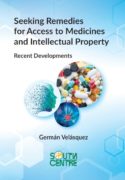
Seeking Remedies for Access to Medicines and Intellectual Property: Recent Developments
About the Book: This book is a collection of research papers by Germán Velásquez published by the South Centre, between 2015 and 2019 on the recent international deliberations and negotiations in the United Nations on access to medicines and their relationship with international trade and intellectual property regimes.
Author: Germán Velásquez is the Special Adviser, Policy and Health of the South Centre.
Call for Papers – TRIPS Flexibilities and Public Health (Deadline: 20 October)
The South Centre and the Max Planck Institute for Innovation and Competition are organizing a Global Forum on Intellectual Property, Access to Medicines and Innovation, in Munich, on 9-10 December 2019. The Forum is designed to bring together policymakers from developing countries with established scholars, early career academics and PhD students across multiple disciplines, allowing cross-fertilization of ideas that advance both scholarship and practice in the field.
This call for papers will receive innovative ongoing and/or unpublished research from early career scholars and PhD students on substantive flexibilities in the IP system afforded by the TRIPS Agreement that are relevant to pursue public health goals. Case studies, comparative analyses, empirical and statistical studies, as well as legal reflections with a policy perspective will be considered.
South Centre Statement at the United Nations High Level Meeting on Universal Health Coverage
Access to health is a human right and Universal Health Coverage (UHC) is essential to achieve health for all. States should ensure through public funding, based on solidarity and the fair redistribution of wealth, that nobody is deprived from health care. Policies that promote competitive markets for pharmaceuticals, particularly in the area of procurement, regulatory approvals (including biologicals) and intellectual property, should be implemented. Governments should make use of the available space in the TRIPS Agreement to apply rigorous definitions of invention and patentability standards and use other flexibilities allowed.Below is the South Centre’s Statement to the UN High-Level Meeting on UHC held on 23 September 2019 at the UN headquarters in New York. The Centre noted the recognition, in the draft political declaration, of the responsibilities of governments as well as of their right to choose their own path towards achieving UHC.
Antivirales de acción directa para la Hepatitis C: evolución de los criterios de patentabilidad y su impacto en la salud pública en Colombia
Por Francisco A. Rossi B. y Claudia M. Vargas P.
La hepatitis C en el siglo XXI y el VIH en el final del siglo XX han representado los más relevantes retos de salud pública para la comunidad internacional. No solamente por ser enfermedades infecciosas y transmisibles (razón de ser de la salud pública) sino por su carácter mortal si no se recibe tratamiento de manera oportuna. En Octubre de 2015, la fundación IFARMA solicitó que todos los medicamentos antivirales para la hepatitis C, utilizables para curar una infección crónica transmisible potencialmente mortal, fueran declarados de interés público, dado que su precio amenazaba la sostenibilidad financiera del sistema de salud. Una declaración de interés público para estos medicamentos sería el primer paso para la emisión de licencias obligatorias. Este trabajo se ha llevado a cabo para identificar las patentes existentes en Colombia para estos productos, su alcance y sus consecuencias, en el marco de una discusión sobre la transparencia del sistema de patentes y la evolución del rigor con que se evalúan las solicitudes y se conceden las patentes.
The most expensive drug in the history of the pharmaceutical industry
By Germán Velásquez
On May 27, 2019 the US FDA gave marketing authorization for Zolgensma gene therapy, from the Swiss firm Novartis. The price of the drug, administered in a single dose, is 2.125 million dollars, making it the most expensive drug in the history of the pharmaceutical industry. (more…)