A Review of WTO Disputes on TRIPS: Implications for Use of Flexibilities for Public Health
By Nirmalya Syam
The use of TRIPS flexibilities by WTO members involves interpretation of the obligations under TRIPS which can be challenged under the WTO dispute settlement system. Mutually agreed solutions, panel or Appellate Body decisions adopted in such disputes can thus impact the scope of TRIPS flexibilities to address, among others, public health objectives. This paper explores how the WTO dispute settlement system applies to disputes under TRIPS, and reviews the outcomes of the disputes relating to the implementation of TRIPS obligations in the context of pharmaceutical products. The paper points to both systemic and substantive concerns arising from the application of the dispute settlement system to disputes under TRIPS. It finds that the dispute settlement system is not aligned to the unique nature of the TRIPS Agreement in the WTO as an agreement that creates positive obligations, and consequently how jurisprudence arising under disputes concerning other covered agreements having negative obligations, have led panels and Appellate Bodies to adopt narrow interpretations of the scope of TRIPS flexibilities in some of the few disputes arising under the TRIPS Agreement. Moreover, mutually agreed settlements adopted in the context of some of the disputes arising under TRIPS have also led to the adoption of TRIPS plus standards, limiting the scope of TRIPS flexibilities. However, in a recent decision, the WTO panel has also relied on the Doha Declaration on TRIPS and Public Health as a subsequent agreement to guide the interpretation of its provisions. In this context, the paper advances some suggestions to address the systemic and substantive issues arising from the application of the dispute settlement system to the TRIPS Agreement.
Oral Statement of the South Centre for the Regional Consultation on Sustainable Development and the ICESCR
Geneva, 8 February 2022
The following statement is delivered by the South Centre during the consultation convened by the Drafting Group of the United Nations Committee on Economic, Social and Cultural Rights for the development of a General Comment on Sustainable Development and the International Covenant on Economic, Social and Cultural Rights.
The Right to Health in Pharmaceutical Patent Disputes
by Emmanuel Kolawole Oke
This paper examines how the courts in three developing countries (Kenya, South Africa, and India) have addressed the tension between patent rights on pharmaceutical products and the right to health. The paper begins by examining the nature of the relationship between patent rights and the right to health. It thereafter explores the justiciability of the right to health in Kenya, South Africa, and India. Furthermore, the paper provides an analysis of how the courts in these three developing countries have adjudicated some of the pharmaceutical patent cases involving tensions between the right to health and patent rights. The paper contends that by incorporating the right to health into the adjudication of patent disputes, courts in developing countries can play a crucial role in improving access to medicines at affordable prices.
Mainstreaming Public Health Considerations in Adjudication of Intellectual Property Disputes: Implications of Specialized IP Courts and General Courts
By Justice (Retd.) Prabha Sridevan
How can the public interest dimension be considered in the adjudication of intellectual property (IP) disputes, in particular those concerning patents on health technologies such as medicines and vaccines? This is the main question addressed by Justice (Retd.) Prabha Sridevan, former Judge of the Madras High Court and former Chairperson of the Intellectual Property Appellate Board (IPAB) of India, as an expert facilitator, at the Asian Regional Course for Judges on Intellectual Property and Public Health organized by the South Centre in August 2021. Justice Sridevan addressed the pros and cons of adjudication through specialized courts vis-à-vis general courts.
The Impact of a TRIPS COVID Waiver on Trade and Investment Agreements
Program on Intellectual Justice and Intellectual Property, American University Washington College of Law event
February 4, 2022, 10am EST/3pm GMT
Co-Sponsored by the American Branch of the International Law Association and the South Centre
The event will feature a presentation of a South Centre Research Paper by Federica Paddeu and Henning Grosse Ruse-Khan, followed by a round table discussion with international law experts. The Seminar is scheduled for 90 minutes in a public and recorded session, followed by a 30 minute off-camera virtual reception held under Chatham House Rule.
Palabras de Germán Velásquez al recibir « LA ORDEN DEL CONGRESO DE COLOMBIA » otorgada por el Senado de la República
Cartagena de Indias, 26 de Enero del 2022
“EL TEMA CENTRAL DE MI LUCHA EN LOS ULTIMOS 15 AÑOS ES QUE UN MEDICAMENTO QUE PUEDE SALVAR UNA VIDA NO PUEDE SER EL OBJETO DE UN MONOPOLIO PROTEGIDO POR UNA PATENTE… ES POR ESO QUE YO PIENSO Y CREO QUE LAS VACUNAS Y TRATAMIENTOS PARA LA COVID 19 DEBEN SER CONSIDERADOS COMO UN BIEN PUBLICO COMUN.”
A TRIPS-COVID Waiver and Overlapping Commitments to Protect Intellectual Property Rights Under International IP and Investment Agreements
by Henning Grosse Ruse-Khan and Federica Paddeu
This paper considers legal implications that are likely to emerge from the implementation of a TRIPS Waiver decision. Assuming that a Waiver is adopted in the form presented in the May 2021 proposal by South Africa and India et al, we review the interaction between the Waiver and other commitments to protect IP rights under international IP and investment treaties. Our principal research question is to analyze whether domestic measures implementing the Waiver are compatible with the implementing State’s other obligations to protect IP rights established under multilateral IP treaties, IP and Investment Chapters of FTAs as well as BITs. In light of typical examples for such overlapping commitments, we first focus on (1) defences directly affecting compatibility with these treaty commitments (here referred to as ‘internal’ defences). In a second part, we review (2) potential defences under general international law that may serve to justify (in other words, to preclude the wrongfulness of) such measures. We conclude that often internal and/or general defences will operate to support the implementation of the Waiver despite overlapping commitments in international IP and investment law. This conclusion is reinforced by a purpose-oriented understanding of the TRIPS Waiver as authorizing measures necessary to achieve the goal of “unimpeded, timely and secure access” for all to covered medical technologies “for the prevention, treatment or containment of COVID-19”.
South Centre Statement to the WHO Executive Board 150th Session
The South Centre, the intergovernmental organization of 54 developing countries from Africa, Asia, Latin America and the Caribbean, considers that key outcomes from the work of the 150th Executive Board should include…
Call for Papers for LEAD Journal Special Issue 2022
PLANETARY HEALTH IN TIMES OF CONVERGING CRISES – CHALLENGES AND OPPORTUNITIES
The Law, Environment and Development Journal (LEAD) Journal Special Issue 2022 will reflect on environmental issues in the context of the Stockholm Conference’s 50th anniversary and the COVID-19 crisis.
Direito Brasileiro da Concorrência e Acesso à Saúde no Brasil: Preços Exploratórios no Setor de Medicamentos
Por Bruno Braz de Castro
O presente trabalho tem por objeto analisar interfaces entre o Direito da Concorrência brasileiro e o tema do acesso a medicamentos, com especial atenção aos abusos de direitos de propriedade industrial em seus efeitos exclusionários e exploratórios. O trabalho analisa a jurisprudência do Conselho Administrativo de Defesa Econômica (CADE) no setor de medicamentos e discute os abusos visando à imposição ilegítima de direitos de propriedade intelectual inexistentes ou inválidos com finalidade anticompetitiva. Em seguida, aborda os abusos no exercício de direitos de propriedade industrial que sejam, por si, válidos: práticas exclusionárias, voltadas à elevação artificial de barreiras à entrada, e práticas exploratórias, traduzidas diretamente no exercício de poder de mercado em detrimento ao consumidor. Estas últimas são manifestadas na forma de preços excessivos exploratórios, degradações contratuais, de qualidade ou de privacidade, bem como restrições na oferta como o açambarcamento/impedimento de exploração de direitos de propriedade industrial. O artigo conclui pela validade e eficácia jurídica da proibição a preços exploratórios pela Lei de Defesa da Concorrência vigente, com certas preocupações metodológicas a fim de minorar o risco de condenações errôneas (como a construção de testes “screening” de mercados-candidatos a intervenção). Em atenção a tais diretrizes, o setor de medicamentos comparece como candidato importante à atenção antitruste, haja vista a magnitude dos prejuízos potencialmente derivados da não-intervenção sobre a prática. Remédios nessa seara, de modo importante, devem focar na identificação e solução dos problemas competitivos estruturais do setor. Em caso de medicamentos sujeitos à regulação de preços pela Câmara de Regulação do Mercado de Medicamentos (CMED), a expertise técnica da autoridade concorrencial poderá ser de grande valia em sede de advocacia da concorrência, o que é demonstrado à luz das discussões recentes acerca do reajuste extraordinário de preços em virtude de problemas concorrenciais de determinado mercado.
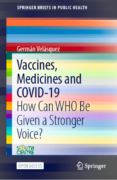
The considerable health, economic and social challenge that the world faced in early 2020 with COVID-19 continued and worsened in many parts of the world in the second half of 2020 and into 2021.
How can an agency like WHO be given a stronger voice to exercise authority and leadership?
This book is a collection of research papers produced by the author between 2020 and early 2021 that helps answer this question. The topics address the state of thinking and debate – particularly with regard to medicines and vaccines – that would enable a response to this pandemic or subsequent crises that may emerge.
This book presents the South Centre’s reflections and studies to provide policymakers, researchers and other stakeholders with information and analysis on issues related to public health and access to medicines and vaccines in the context of COVID-19.
Author: Germán Velásquez, Special Adviser for Policy and Health of the South Centre







 Description: