SOUTH CENTRE STATEMENT FOR CBD SBSTTA AGENDA ITEM ON BIODIVERSITY AND HEALTH
The draft Global Action Plan on Biodiversity and Health should support mainstreaming biodiversity and health linkages in national policies, strategies, programmes and accounts.
The South Centre suggests the following amendments to the draft Action Plan on Biodiversity and Health to ensure consistency with the objectives of the Convention and the Nagoya Protocol with regard to fair and equitable benefit-sharing…
Addressing Food Insecurity and Climate Change for Poverty Reduction in the Horn of Africa
By Ali Issa Abdi
This article provides an assessment of the impact of food insecurity and climate change on poverty reduction in the Horn of Africa (HoA), which is one of the most affected regions in the world by these interlinked challenges. The region is confronted by these interconnected and mutually reinforcing negative conditions, which are compounded by institutional constraints, insecurity and scarce financial resources. Consequently, to end hunger, malnutrition and poverty in all its forms by 2030, it is imperative to implement urgent and radical transformation of food production systems, and to adopt accelerated and scaled up global actions to strengthen resilience and people’s livelihoods in response to climate variability and extremes.
The WTO TRIPS Waiver and Essential Security Rights in 2022
By Dr. Alexander Beyleveld
Almost two years have passed since the start of the COVID-19 pandemic, and we are still far from bringing the pandemic to an end. One of the main reasons for this is the fact that large vaccine inequities remain worldwide. In order to address this problem, a large subset of World Trade Organization (WTO) members are in favour of waiving certain obligations contained in the Agreement on Trade Related Aspects of Intellectual Property Rights (TRIPS Agreement). Against this backdrop, this article contemplates the legal necessity of such a waiver given that Article 73 of the TRIPS Agreement contains essential security exceptions which may render the obligations in question inapplicable under the interpretation that the pandemic affects law and public order interests.
These comments by the BEPS Monitoring Group (BMG) analyse the draft model rules on nexus and revenue sourcing, released by the OECD Secretariat on 4 February 2022 for public consultation, in the continuing work to address the tax challenges of the digitalised economy by the Task Force on the Digital Economy (TFDE) set up by the G20/OECD Inclusive Framework on BEPS. The BMG is a network of experts on various aspects of international tax, set up by a number of civil society organizations which research and campaign for tax justice including the Global Alliance for Tax Justice, Red de Justicia Fiscal de America Latina y el Caribe, Tax Justice Network, Christian Aid, Action Aid, Oxfam, and Tax Research UK. This report has not been approved in advance by these organizations, which do not necessarily accept every detail or specific point made here, but they support the work of the BMG and endorse its general perspectives. It is based on our previous reports, and has been drafted by Sol Picciotto and Jeffery Kadet, with comments and contributions by Abdul Muheet Chowdhary, Sakshi Rai, Sudarshan Rangan, Attiya Waris and Yansheng Zhu.
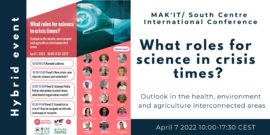
Discussions among eminent specialists will address new crisis scenarios related to health, environment and agriculture in their different dimensions, examine the complex science-policy-public interactions at play, and the role of science and scientists in the search for sustainable and long-lasting solutions for crisis resolution.
The conference will be organized in a hybrid format, with options for in-person and online attendance. Interpretation will be available in French and English.
The International Discourse on the Right to Development and the Need to Reinvigorate its Implementation
By Yuefen Li, Daniel Uribe and Danish
The world is currently at an ebb for realizing the Right to Development (RtD). Weakening of multilateralism, de-globalization, the scars left by the COVID-19 pandemic, misinterpretation and dilution of the RtD, and inertia to reform international governance are among the multitude of reasons for this phenomenon. However, the need for a better, more inclusive and greener recovery, and the efforts necessary to attain the 2030 Agenda, have provided the international community an opportunity to reinvigorate the realization of the RtD. These efforts have shown the great relevance of RtD to promote a people-centred and fairer development process and the need for an international enabling environment in order to promote the kind of development we want.
This paper reviews the history of international discourse on RtD including major milestones, main divisive issues between the global South and the North, the evolution of voting patterns on intergovernmental outcomes, existing legal and political issues currently being discussed, the various mechanisms on the RtD, and recommendations on the way forward to revitalize the implementation of RtD at the 35th anniversary of the Declaration on Right to Development.
Marine Genetic Resources Beyond National Jurisdictions: Negotiating Options on Intellectual Property
By Siva Thambisetty
Negotiations on marine biological diversity of areas beyond national jurisdiction (BBNJ) convene after a significant hiatus during which intellectual property monopolies have come under intense normative and pragmatic scrutiny. This paper historicises developments in legal arrangements over intellectual property and biodiversity to propose several negotiating options on the control, use and circulation of marine genetic resources of areas beyond national jurisdiction. The text-based options presented here operationalise an equitable approach taking into account the interests of low power groups, cross-cutting issues and the often ignored question of the ownership and use of marine genetic resources through intellectual property rights.
South Centre Comments on Draft Model Rules for Tax Base Determinations
The South Centre today provided its comments to the OECD Inclusive Framework’s Task Force on Digital Economy (TFDE) on the Draft Model Rules for Tax Base Determinations. These rules are part of the overall OECD project on the taxation of the digitalized economy known as Pillar One. They determine the amount of a Multinational Enterprise’s (MNE) profits that will then be partially redistributed to market jurisdictions, which are expected to be largely developing countries.
The Model Rules for Tax Base Determinations are of importance as this affects the amount of tax revenues that developing countries will finally be able to collect under the so-called “Amount A” of Pillar One.
Direct Monetary Costs of Intellectual Property for Developing Countries
A changing balance for TRIPS?
It is startling that almost no discussion exists on the direct monetary costs for countries of the IP international regulatory framework. Indeed, on top of the inherent costs on ´access´ or ´learning´ abilities, there are some important tangible, measurable, direct monetary costs to countries. These costs are the financial payments that occur simply for the use of intellectual property. These payments are relevant in any discussion on the role of IP in the context of development.
An overview of some findings is presented in this report, with the aim of promoting an assessment and discussion at the WTO and other fora whenever there is a consideration of the impacts of the IP international regulatory framework, notably the Agreement on Trade-Related Aspects of Intellectual Property Rights (TRIPS Agreement) in individual countries.
Can Negotiations at the World Health Organization Lead to a Just Framework for the Prevention, Preparedness and Response to Pandemics as Global Public Goods?
By Viviana Muñoz Tellez
This paper advances that WHO Member States, having agreed to the objectives of advancing equity and solidarity for future pandemic prevention, preparedness and response, now must operationalize these. The paper offers suggestions for the ongoing WHO processes of: 1) review of recommendations under examination by the Working Group on Strengthening WHO Preparedness and Response to Health Emergencies, 2) consideration of potential amendments to the International Health Regulations (IHR) 2005, and 3) elaboration of a draft text for an international instrument on pandemic preparedness and response.
The global minimum tax should provide an incentive for developing countries to raise their effective tax rate as close as possible to their statutory tax rates, which are often higher than the 15% rate. The average rate for South Centre and G-77+China Member States is around 25%. In any case it should be at least 15%, since any undertaxed profits would in any case be taxed at that rate by developed countries. Leading OECD countries have already adopted measures to protect their source tax base, which they intend to retain, such as the UK’s diverted profits tax and the US’s base erosion anti-abuse tax. Poorer countries have even more reason to do likewise. They should consider introducing or strengthening measures such as an alternative minimum tax on deemed or book profits, versions of which already exist in many countries. These are compatible with the GloBE rules, and should be regarded as an essential complement, to ensure that it contributes to both fair and effective taxation of MNE profits.
South Centre Comments on Draft Model Rules for Nexus and Revenue Sourcing
The South Centre offers its comments on the Draft Model Rules for Nexus and Revenue Sourcing. As a procedural matter, the extremely rapid pace of discussions is a matter of great concern for developing countries, a matter also raised by the African Tax Administration Forum (ATAF). While an urgent solution is needed to the taxation of the digitalization of the economy, this must mean one which incorporates the interests of developing countries.