Political Declaration on the occasion of the twenty-fifth anniversary of the Fourth World Conference on Women
Ministers and representatives of governments of the Member States of the United Nations met at a special one-day session of the 64th meeting of the Commission on the Status of Women (CSW64) and adopted a Political Declaration commemorating the 25th anniversary of the Fourth World Conference on Women, held in Beijing in 1995, and its major seminal output, the Beijing Declaration and Platform for Action (BD & BPfA).
The ISDS Reform Process: The missing development agenda
By Nicolás M. Perrone
The foreign direct investment (FDI) governance agenda is centred on the reform of international investment agreements (IIAs) and investor-state dispute settlement (ISDS). The proliferation of IIAs and ISDS has contributed to narrowing the FDI agenda. A key policy question is whether this fragmented approach remains consistent with the 2030 Sustainable Development Goals (SDGs). Current FDI discussions point at the need for a holistic approach in this policy area, quite the opposite of a regime primarily aimed to protect foreign investors through treaty standards and international arbitration. The realisation of the SDGs depends on multi-stakeholder partnerships to combat poverty and provide clean water and energy to the world population. Crucially, these partnerships will require more cooperation and coordination than IIAs and ISDS can promote and nurture.
In a more and more climate change threatened world, Africa’s energy vision should be premised on moving from an energy landscape based on underdeveloped and carbon intense pathways to a modern, clean and decentralized energy system. This transition is a critical enabler of meaningful and endogenous socio-economic development. While the continent may face a broad set of challenges in achieving this vision, it has at the same time the opportunity to avoid the fossil fuel lock-in that many industrialized countries face and to take advantage of vast supplies of untapped energy resources and/or any stranded asset problem. The Africa Energy Transition Program in the making under the auspices of the African Energy Commission forms a continent-wide and coordinated approach in facilitating the required transformation for the realization of Africa’s development aspiration.
Submission by the South Centre to the Draft Issues Paper on Intellectual Property Policy and Artificial Intelligence (WIPO/IP/AI/2/GE(20/1)
The South Centre welcomes the opportunity to submit to the WIPO Secretariat input on the draft issues paper on intellectual property policy (IP) and artificial intelligence (AI). The South Centre hereby provides recommendations for the revised Issues Paper. The aim of the Issues Paper should be to provide a framework for informed discussion among Member States on the topic of IP policy and AI, without pre-empting the substance of such discussion, and to complement a process of sharing of views and experiences between different Member States and constituencies. The Development Agenda should also be mainstreamed into the discussion of IP policy and AI.
Comments by the South Centre on the CESCR Draft General Comment on science and economic, social and cultural rights Art. 15: 15.1.b, 15.2, 15.3 and 15.4
The South Centre welcomes the opportunity to submit its comments on the Committee on Economic, Social and Cultural Right (CESCR) Draft General Comment on science and economic, social and cultural rights Art. 15: 15.1.b, 15.2, 15.3 and 15.4 and commends the Secretariat of the CESCR for this initiative. We recognize the paramount importance of the ESCR and of Art. 15, which is a crucial element to ensuring other rights and the development of all countries. We further acknowledge and reinforce the importance of the draft text to address multiple emerging and long-established issues, such as the risks and promises of the 4th Industrial Revolution and the relation of science and the right to food as two examples.
Reforms to Investor-State Dispute Settlement (ISDS) are being discussed in the United Nations Commission on International Trade Law (UNCITRAL) Working Group III. One possible reform is the development of an appellate mechanism, either as part of the proposed two-tier standing investment court, or as a stand-alone appellate mechanism. From the perspective of developing countries as host states that face possible claims from investors, how appealing is an appellate mechanism in ISDS?
The Role of South-South Cooperation in Combatting Illicit Financial Flows
By Manuel F Montes
Developing countries bear the brunt of costs from illicit financial flows (IFFs). These losses are the result of the facilities that the global system provides transnational companies, operating in multiple tax jurisdictions, to move their profits to favorable locations. International cooperation has been seen to be a key ingredient in restricting IFFs. However, a difference in interests in the treatment of many types of transactions between developed and developing countries is an obstacle to a fast solution of the problem. Developing countries must seek to seize the initiative to restrict their losses from IFFs. They can deploy various joint and concerted actions, within the umbrella of the principles of South-South cooperation for this purpose.
Eighteen Years After Doha: An Analysis of the Use of Public Health TRIPS Flexibilities in Africa
By Yousuf A Vawda and Bonginkosi Shozi
As we observe the 18th anniversary of the Doha Declaration on the TRIPS Agreement (Agreement on Trade-Related Aspects of Intellectual Property Rights) and Public Health, it is appropriate to take stock of intellectual property developments and endeavour to present a comprehensive account of the situation in the African continent in respect of the implementation of TRIPS flexibilities, specifically those regarding access to medicines. This research paper provides an overview of the extent to which selected African countries have adopted legal and policy frameworks with regard to TRIPS flexibilities, examines the actual use of these flexibilities in enabling access to medicines in those countries, and suggests some recommendations for optimising the use of the flexibilities in pursuing public health imperatives.
US-China trade deal: preliminary analysis of the text from WTO perspective
By Peter Lunenborg
The long-awaited ‘Phase 1’ trade deal between the United States and China, officially termed the ‘Economic and Trade Agreement between the Government of the United States of America and the Government of the People’s Republic of China’, was signed on 15 January 2020. It will enter into force on Valentine’s Day, on Friday, 14 February 2020. This deal is a result of US exercise of political power and unilateral World Trade Organization (WTO)-inconsistent tariffs in order to extract trade concessions, an expression of the most pure protectionism that the WTO is supposed to prevent. Nevertheless, the WTO was unhelpful in addressing the US economic aggression against China. This failure to protect a Member from illegitimate unilateral measures is, perhaps, one of the most significant manifestations of the often-mentioned ‘crisis’ of the WTO, and actually is one of the subjects on which the proposed ‘reform’ of the organization should focus.
Third Annual Developing Country Forum on South-South Cooperation in International Tax Matters (Report)
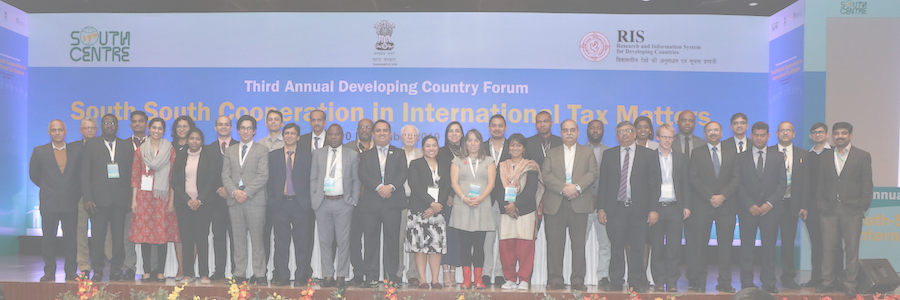
The South Centre organized, in cooperation with the Research and Information System for Developing Countries (RIS), the Ministry of External Affairs and the Ministry of Finance of India, the Third Annual Developing Country Forum on South-South Cooperation in International Tax Matters (the Forum). The Forum is an activity of the South Centre Tax Initiative (SCTI) which serves as a platform owned by developing countries to facilitate the networking and access to their officials to technical and academic resources, as well as to provide a venue for discussion among developing countries to identify collective efforts towards their participation in international tax fora and negotiations on matters of global economic governance. Discussions during the forum addressed the most relevant tax issues that may impact developing countries currently being discussed at the international level, especially in the OECD. The Forum also allowed the exchange of expertise among developing countries coming from Asia and the Pacific, Latin America and the Caribbean, and Africa, which consolidated this space as a necessary mechanism to identify coordinated positions among developing countries towards the consolidation of a network of tax officials from developing countries and strengthening their voice in the international fora.
The Fourth Industrial Revolution in the Developing Nations: Challenges and Road Map
By Sohail Asghar, Gulmina Rextina, Tanveer Ahmed & Manzoor Illahi Tamimy
Technological advancements and the amalgamation of several fields, including Advanced Robotics, Artificial Intelligence (AI), Big Data Analytics, Cyber Security, Cloud Computing, and Internet of Things (IoT) have brought the world on the cusp of a Fourth Industrial Revolution (FIR). This industrial revolution has the potential to sky rocket economic growth or on the other hand, cause countries to lag behind in terms of economic development if the potential of FIR is not exploited. A number of developed countries such as Germany, the UK and USA have put in place public policies that focus on implementing FIR in their respective countries. It is critical that developing countries also take steps to adapt FIR in order to take advantage of it as well as not be adversely affected by these technologies if not adopted. There are a number of reasons why developing countries are not able to fully implement FIR technologies such as lack of commitment, infrastructure and lack of skilled workers. The objective of this study is to identify the challenges and issues faced by the developing countries in the implementation of the FIR. This study proposes a strategic framework: “Centre for the Fourth Industrial Revolution (CFIR)” for developing countries in order to face the challenges of FIR. Consequently, CFIR will work on establishing research labs for capacity building through collaboration and establishing technology-based incubation centers. CFIR will bring together an international network of governments, leading companies, civil society and experts to co-design and pilot innovative policy and governance frameworks.
Western Indian Ocean (WIO) Regional Meeting of the High Level Panel (HLP) on the Sustainable Ocean Economy Report
African countries called for action to address issues that are unique to Africa on fisheries, climate change and ocean health and wealth and discussed an African position in preparation for the United Nations Ocean Conference 2020 and the 12th World Trade Organization (WTO) Ministerial Conference, at the Western Indian Ocean (WIO) regional meeting of the High Level Panel on the Sustainable Ocean Economy (HLP), Mombasa, Kenya, 2-3 December 2019. Trade ministers should reach agreement in WTO on fisheries’ subsidies, in response to the Sustainable Development Goal (SDG) 14.6 mandate, which calls for States “by 2020, [to] prohibit certain forms of fisheries subsidies which contribute to overcapacity and overfishing, and eliminate subsidies that contribute to illegal, unreported and unregulated (IUU) fishing, and refrain from introducing new such subsidies, recognizing that appropriate and effective special and differential treatment for developing and least developed countries should be an integral part of the WTO fisheries subsidies negotiation.” South Centre provided inputs and guided a discussion on the issue of fisheries subsidies.