Comments on Session Paper relating to tax consequences of the digitalized economy – issues of relevance for developing countries
The SCTI offers its comments on the Session Paper on “Tax consequences of the digitalized economy – issues of relevance for developing countries” (E/C.18/2020/CRP.25) to be discussed at the 20th Session of the UN Committee of Experts on International Cooperation on Tax Matters. The comments examine key issues for developing countries in the Unified Approach (UA) to Pillar One and explore alternative solutions at the international level as discussed in the Paper.
Compilation of Extracts from Selected Country Statements during 73rd World Health Assembly supporting Access to Health Products on COVID-19
The compilation below was done on the basis of published statements on the WHO website (https://apps.who.int/gb/statements/WHA73/) and the speeches delivered orally for those delegations which have not submitted their statements. This is a non-official document for information only.
Comments to the FACTI Panel on improving cooperation in tax matters
The South Centre Tax Initiative (SCTI) would like to draw the attention of the Financial Accountability Transparency and Integrity (FACTI) Panel to the following aspects of improving international tax cooperation:
(1) legal procedure to upgrade the UN Tax Committee into an intergovernmental body;
(2) Right of even Inclusive Framework Members to take unilateral measures;
(3) Need for comprehensive scope of Pillar One;
(4) Primacy of Undertaxed Payments and Subject to Tax rules in Pillar Two;
(5) Need for clear and administrable rules for dispute prevention.
Intellectual Property Rights and the use of Compulsory Licenses: Options for Developing Countries
By Dr. Carlos M. Correa
In view of the forthcoming review of the implementation of the TRIPS Agreement, and of a possible revision of its provisions in future WTO negotiations, it seems important that information is available to developing countries on the ways in which compulsory licenses have been provided for and used in developed and developing countries. The purpose of this paper is to provide concrete examples on how compulsory licenses have been provided for in national laws and, in particular, to illustrate the grounds and conditions on which such licenses have been granted in specific instances. The emphasis of the paper is not on the general principles relevant to the matter, but on the ways in which compulsory licenses have been actually provided for or used in order to satisfy diverse public interests. Many of the decisions pertaining to the granting of compulsory licenses in the developed countries may be useful in indicating the options available to developing countries wishing to have adequate legislation at the national level on this matter. The decisions referred to also make it clear that compulsory licensing is firmly rooted in the legal systems of developed countries, including those that seem to oppose that concept in international fora.
Trade Measures Adopted by Countries in Response to COVID-19
In response to the COVID-19 pandemic, many WTO members have adopted several measures affecting trade. Some are trade liberalizing; others are trade restrictive. South Centre has elaborated a worksheet that compiles these measures (updated till 16 April) based on available sources of information. The compilation does not intend to be exhaustive. However, it may help members to have information about the landscape of trade measures that may affect them.
Intellectual Property and Trade Measures to Address the Covid-19 Crisis by the South Centre
The South Centre views with concern the attempts by some governments and industry players to monopolize the availability of treatments, diagnostics, medicines, medical supplies and devices needed for their own nationalist agenda or to maximize profit, ahead of societal interest in tackling the Covid-19 pandemic. The private enforcement of patents and government trade restrictions may pose a dire threat to the containment of this global public health emergency. Governments should act swiftly to put in place legislation and plans to ensure that patents and trade measures do not become barriers for access to those products.
Contribution of the South Centre to the Report of the Secretary-General on the Implementation of UN General Assembly Resolution A/RES/74/7 dated 12 November 2019 on the “Necessity of ending the economic, commercial and financial embargo imposed by the United States of America against Cuba”
The imposition of unilateral economic, financial and trade measures against Cuba, in violation of basic principles of the United Nations (UN) Charter, has severe socio-economic impacts on the Cuban population. The UN General Assembly adopted by an overwhelming majority the resolution “Necessity of ending the economic, commercial and financial embargo imposed by the United States of America against Cuba” (document A/74/L.6). In response to the request in paragraph 4 of this resolution, the South Centre prepared a contribution to the report of the Secretary-General. This highlights, in particular, the obstacles that the US embargo poses for the attainment of the right to health in Cuba.
Submission by the South Centre to the Draft Issues Paper on Intellectual Property Policy and Artificial Intelligence (WIPO/IP/AI/2/GE(20/1)
The South Centre welcomes the opportunity to submit to the WIPO Secretariat input on the draft issues paper on intellectual property policy (IP) and artificial intelligence (AI). The South Centre hereby provides recommendations for the revised Issues Paper. The aim of the Issues Paper should be to provide a framework for informed discussion among Member States on the topic of IP policy and AI, without pre-empting the substance of such discussion, and to complement a process of sharing of views and experiences between different Member States and constituencies. The Development Agenda should also be mainstreamed into the discussion of IP policy and AI.
Comments by the South Centre on the CESCR Draft General Comment on science and economic, social and cultural rights Art. 15: 15.1.b, 15.2, 15.3 and 15.4
The South Centre welcomes the opportunity to submit its comments on the Committee on Economic, Social and Cultural Right (CESCR) Draft General Comment on science and economic, social and cultural rights Art. 15: 15.1.b, 15.2, 15.3 and 15.4 and commends the Secretariat of the CESCR for this initiative. We recognize the paramount importance of the ESCR and of Art. 15, which is a crucial element to ensuring other rights and the development of all countries. We further acknowledge and reinforce the importance of the draft text to address multiple emerging and long-established issues, such as the risks and promises of the 4th Industrial Revolution and the relation of science and the right to food as two examples.
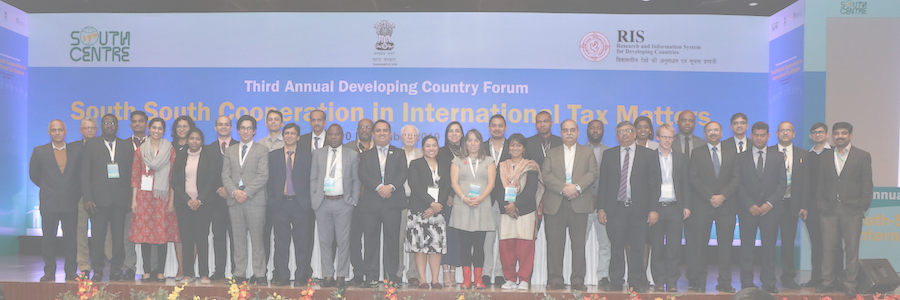
Third Annual Developing Country Forum on South-South Cooperation in International Tax Matters (Report)
The South Centre organized, in cooperation with the Research and Information System for Developing Countries (RIS), the Ministry of External Affairs and the Ministry of Finance of India, the Third Annual Developing Country Forum on South-South Cooperation in International Tax Matters (the Forum). The Forum is an activity of the South Centre Tax Initiative (SCTI) which serves as a platform owned by developing countries to facilitate the networking and access to their officials to technical and academic resources, as well as to provide a venue for discussion among developing countries to identify collective efforts towards their participation in international tax fora and negotiations on matters of global economic governance. Discussions during the forum addressed the most relevant tax issues that may impact developing countries currently being discussed at the international level, especially in the OECD. The Forum also allowed the exchange of expertise among developing countries coming from Asia and the Pacific, Latin America and the Caribbean, and Africa, which consolidated this space as a necessary mechanism to identify coordinated positions among developing countries towards the consolidation of a network of tax officials from developing countries and strengthening their voice in the international fora.
Intellectual Property and Access to Medicines: An Introduction to Key Issues – Some Basic Terms and Concepts
Intellectual property and patents in particular, have become one of the most debated issues on access to medicines, since the creation of the World Trade Organization (WTO) and the coming into force of the Agreement on Trade-Related Aspects of Intellectual Property Rights (TRIPS). Patents are by no means the only barriers to access to life-saving medicines, but they can play a significant, or even determinant, role. During the term of patent protection, the patent holder’s ability to determine prices, in the absence of competition, can result in the medicine being unaffordable to the majority of people living in developing countries. This first issue of the “South Centre Training Materials” aims, in its first part, to provide an introduction to key issues in the field of access to medicines and intellectual property. The second part describes and defines some basic terms and concepts of this relatively new area of pharmaceuticals policies which are the trade related aspects of intellectual property rights that regulate the research, development and supply of medicines and health technologies in general.