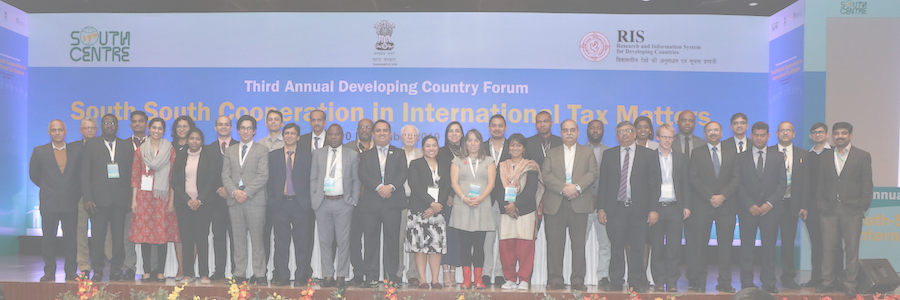
STATEMENT BY DR. CARLOS CORREA, EXECUTIVE DIRECTOR OF THE SOUTH CENTRE, TO THE MINISTERS AND GOVERNORS MEETING OF THE INTERGOVERNMENTAL GROUP OF TWENTY-FOUR (G-24)
11 April 2023, Washington, D.C.
Solidarity and international cooperation is needed now more than ever to address the multiple challenges that disproportionately affect developing countries. See the South Centre’s statement to the G-24.
Preserving Regulatory Space for Sustainable Development in Africa
By Roslyn Ng’eno
Investment has an important role for achieving sustainable development in developing countries. Although international investment agreements (IIAs) can serve as instruments to promote such objective, protection oriented IIAs have undermined the ability of States to regulate in the benefit of the community. Likewise large financial reparations imposed by arbitral tribunals have increased the threat of regulatory chill in the face of major global challenges. Strengthening the right to regulate of States and addressing regulatory chill are key matters to consider in the reform of IIAs and the international investment regime.
Antimicrobial Resistance, pharmaceuticals and environment
South Centre Virtual Workshop, 28 & 29 March 2023, 2:30-4:30 PM CET
The emergence and spread of resistant genes and pathogens among and between humans, animals and the environment is a global threat. Join to learn and share how civil society is tackling these issues and how to elicit ways such efforts might seed or scale more broadly such action.
This workshop is organized with the support of the United Nations Environment Programme (UNEP) and the European Commission.
De dónde viene y a dónde va el financiamiento para la salud mundial
Por Germán Velásquez
En teoría la OMS es la agencia coordinadora de la salud mundial, y los grandes actores, privados y públicos, revindican la relevancia y el rol central de esta agencia de Naciones Unidas. En la práctica, paradójicamente, los dineros para la salud van en gran parte a otras instituciones y no a la OMS o incluso se crean nuevas instituciones o mecanismos donde se canalizan los nuevos fondos (GAVI, Fondo Mundial, Act-A, CEPI, COVAX etc.) Estas instituciones o mecanismos son, en la mayoría de los casos, partenariados público-privados donde está presente la industria farmacéutica. La Ayuda Oficial para el Desarrollo es importante pero sólo representa el 1% de lo que invierten los países en desarrollo en salud. En qué se gasta para promover la salud global y a dónde va este dinero es el objeto de este documento. Una de las preguntas que debemos hacernos tras la experiencia con COVID-19 es cómo vamos a preservar el interés público global mediante la creación de bienes públicos comunes y la protección de los derechos humanos en las actividades de prevención, preparación y respuesta a las pandemias presentes y futuras.
Contribución del Centro Sur al Informe del Secretario General sobre la aplicación de la Resolución A/RES/77/7 de la Asamblea General de la ONU sobre la “Necesidad de poner fin al bloqueo económico, comercial y financiero impuesto por los Estados Unidos de América contra Cuba”
Esta aportación del Centro Sur se presenta en respuesta a la solicitud del Secretario General como contribución al informe del Secretario General de acuerdo a la resolución A/RES/77/7, con respecto a la imposición de medidas económicas, financieras y comerciales unilaterales por parte de los Estados Unidos de América, contra Cuba, en violación de los principios básicos de la Carta de las Naciones Unidas.
Taxation of Computer Software: Need for Clear Guidance in the UN Model Tax Convention
By Abdul Muheet Chowdhary and Sebastien Babou Diasso
Developing countries pay enormous sums of money for the right to use intellectual property such as patents, trademarks, copyrights, etc. Such payments are known as ‘royalties’. The scale is enormous, and just 27 South Centre Member States paid $45 billion in 2020 as royalties. Some proportion of these payments are for the right to use computer software. Developing countries can gain significant revenues if the United Nations can provide clear international tax guidelines that payments for the right to use computer software should be taxable as royalties. This Policy Brief provides the world’s first country-level revenue estimates for 34 of the South Centre’s Member States and finds that they could collect potentially $1 billion in tax revenues in 2020 had they been able to tax payments for the use of computer software as royalties.
Enforcing Secondary Taxing Rights: Subject to Tax Rule in the UN Model Tax Convention
By Abdul Muheet Chowdhary and Sebastien Babou Diasso
The Global Anti Base Erosion (GloBE) Rules under OECD’s Pillar Two recommendations, with a minimum effective tax rate of 15%, are expected to play a significant role to end the ‘race to the bottom’ in corporate taxation, which is one of the main drivers of profit shifting. However, the thrust of these rules is designed in a manner to give priority to the developed countries. In this light, the Subject to Tax Rule (STTR), which is a treaty-based rule that allows source jurisdictions to impose limited source taxation on certain payments that are taxed below a minimum rate in the country of residence, is of extreme significance for the developing countries. Under Pillar Two, application of STTR is restricted to base eroding payments or mobile income between related parties only, which does not address Base Erosion and Profit Shifting (BEPS) concerns in an entirety. That apart, the withholding tax rate of 9% proposed by the OECD may not result in generation of significant resources for the developing countries. In this light, developing countries keenly expect that the UN Tax Committee should devise an STTR that is simple to operate, has a broad scope covering all payments in a tax treaty and imposes a higher withholding tax closer to 15% to bring meaningful revenues for them. Also, developing countries desire that STTR provisions may be introduced at the earliest so as to speedily implement them through the UN Multilateral Instrument under contemplation. This Policy Brief also examines existing average withholding tax rates on interest and royalty payments in existing tax treaties of 48 South Centre and 52 G-77+China Member States and finds that out of a total of 100 developing countries, only 25 would stand to benefit from the STTR in its restricted form in Pillar Two, further strengthening the need for an improved version formulated by the United Nations.
Experiencias internacionales sobre la concesión de licencias obligatorias por razones de salud pública
Por Catalina de la Puente, Gastón Palopoli, Constanza Silvestrini, Juan Correa
El presente estudio tiene como objetivo analizar los regímenes de licencias obligatorias (LOs) en países seleccionados, en particular los elementos económicos de la concesión de las LOs, la determinación y negociación de regalías al titular del derecho. Para ello se realizó un análisis descriptivo y exploratorio de experiencias de concesión de LO en países seleccionados, con foco en las experiencias de los países en vías de desarrollo por su proximidad al caso argentino.
En particular se discuten los ejemplos de experiencias de emisión de medidas de LOs o de UG en países en vías de desarrollo. Con especial foco en Latinoamérica, donde sólo dos países han hecho uso de dichas medidas por razones sanitarias (Ecuador y Brasil). Además se examina la eficacia del empleo de LO o de UG en la reducción de precios donde se evidencian ahorros significativos Como conclusión se propone elaborar una metodología en relación a las regalías para Argentina mediante un rango de pago que tome en consideración criterios de accesibilidad y asequibilidad poblacional a la tecnología licenciada, así como la sustentabilidad de los presupuestos de los agentes financiadores.
Respecting, protecting and fulfilling the rights of peasants and other rural workers – A clever move in times of multiple crises
A side-event to the 52 session of the United Nations (UN) Human Rights Council
Palais des Nations, Geneva, 15 March 2023
The side-event was co-organized by the Permanent Missions of the Plurinational State of Bolivia, Honduras, South Africa, Luxembourg, South Centre, La Via Campesina, Centre Europe – Tiers Monde (CETIM), FIAN International and the Geneva Academy of international humanitarian law and human rights; with the support of some other partners.
Submission by the South Centre to the USITC hearing on Covid-19 diagnostics and therapeutics
India, South Africa and co-sponsors made a proposal for a waiver to certain provisions of the provisions of the WTO Agreement on Trade Related Aspects of Intellectual Property Rights (TRIPS) in March 2020. In June 2022, the WTO Ministerial Decision on the TRIPS Agreement provided a partial waiver to obligations in Article 31, namely an exception to the 31.f export restrictions, in relation to patents for Covid-19 vaccines. No decision has yet been made with respect to diagnostics and therapeutics for Covid-19.
In this context, the U.S. Trade Representative (USTR) requested the U.S. International Trade Commission (USITC) to prepare a report on Covid-19 diagnostics and therapeutics.
Read below the submission by the South Centre to the USITC investigation: COVID-19 Diagnostics and Therapeutics: Supply, Demand, and TRIPS Agreement Flexibilities (Inv. No. 332-596).
South Centre Inputs to UN Secretary-General for “Promotion of inclusive and effective tax cooperation at the United Nations”
The South Centre submits the following comments and recommendations to the UN Secretary-General for the report being prepared in response to UN General Assembly resolution 77/244 on “Promotion of inclusive and effective tax cooperation at the United Nations.”
Análisis de las intersecciones entre cambio climático y derechos humanos
Por Daniel Uribe Terán y Luis Fernando Rosales
Los efectos del cambio climático en la vida diaria de las personas amenazan el pleno disfrute de los derechos humanos. El Consejo de Derechos Humanos ha adoptado dos resoluciones históricas en las que se reconoce por un lado el derecho humano a un medio ambiente limpio, saludable y sostenible (Resolución 48/13), y se establece por otro el mandato de un Relator Especial sobre la promoción y la protección de los derechos humanos en el contexto del cambio climático (Resolución 48/14). Aun así, parece existir la necesidad de que la CMNUCC y la estructura de derechos humanos de las Naciones Unidas mantengan un diálogo más amplio a fin de dar con una respuesta coordinada y coherente al cambio climático y sus efectos sobre los derechos humanos.
En este documento de investigación se analizan las intersecciones de estos dos sistemas jurídicos. Para ello, se identifica el modo en que las negociaciones relativas al cambio climático y la estructura de derechos humanos pueden contribuir a fortalecer la cooperación internacional. También se reconoce la necesidad de un debate internacional de mayor calado acerca de las relaciones entre los derechos humanos y el cambio climático, coherente con los principios de equidad y las responsabilidades comunes pero diferenciadas del CMNUCC.