South Centre Inputs on Workstream III on dispute prevention and resolution (Co-Leads’ Draft Protocol on the Prevention and Resolution of Tax Disputes)
24 August 2026
The South Centre supports the development of an effective multilateral framework for the prevention and resolution of tax disputes. The Protocol should reflect the different capacities of States and provide sufficient flexibility for broad participation.
The Protocol should contain sufficient legal and procedural detail to provide a legal basis for mechanisms where none currently exist and to ensure coherence with mechanisms available under existing instruments. As such, the protocol itself should establish who can invoke it, when it applies, the obligations of competent authorities, and the relationship with existing instruments, and minimum procedural safeguards. Detailed operational procedures such as how an advance pricing arrangement (APA) or joint audit is conducted or mediator is appointed should be addressed through accompanying guidance issued by the Parties to the Protocol.
The protocol should cover the broad range of dispute-prevention mechanisms, but none should be mandatory, to allow flexibility given different State capacities.
The Mutual Agreement Procedures (MAPs) could constitute the core mechanism for the resolution of tax disputes under the Protocol, as it has a well-established basis in international tax practice.
The Protocol should not establish mandatory arbitration. Any arbitration mechanism, if retained, should be expressly voluntary and based on the consent of all competent authorities concerned.
The timelines provided in the protocol should be indicative rather than hard deadlines.
The protocol should provide for capacity building and technical assistance for the implementation.
South Centre Inputs on Workstream II on Taxation of Services (Co-Lead’s Draft Protocol on the Taxation of Income from Cross-Border Services)
26 August 2026
The South Centre welcomes the Draft Protocol on the Taxation of Income from Cross-Border Services and submits the following comments:
Scope: Cover all cross-border services broadly, not limiting it to technical and digital services alone, to avoid fragmentation.
Optionality: No reservations on key substantive provisions (Articles 5, 6, 7, 9); reservations permitted only for non-key administrative/procedural matters (e.g., rates, timelines).
Article 1. Subject to tax rule can apply to cross-border services income within Protocol scope, with the statutory rate fixed in the Protocol; extend paragraph 4’s residence state preservation to Articles 5–11.
Taxes covered: Exclude excise taxes.
Define “beneficial owner,” “payer,” “payment,” and “special relationship“; as applied in Articles 5 and 6.
The automated digital services list in Article 6(4) should be expressly non-exhaustive.
The protocol should provide guidance on nexus and revenue-sourcing rules under Articles 5 and 6, particularly for remote/data-driven monetization with no direct in-country payment.
The protocol should broaden “physical presence” beyond employees/agents and provide guidance on profit-allocation methods, including simplified profit allocation approaches under Article 9.
Existing treaties: Where inconsistent with an existing treaty, the Protocol should ideally automatically override the relevant provisions. However, in case treaty-by-treaty renegotiation is preferred, then the Protocol should trigger mandatory renegotiation within a defined timeframe aligned with Article 21 of the Framework Convention.
Implementation: In case the option of treaty-by-treaty renegotiation is chosen, then implementation can be done by a UN Fast-Track Instrument to streamline bilateral treaty alignment.
South Centre Inputs on Workstream I – Co-Lead’s Zero Draft of UN Framework Convention on International Tax Cooperation
26 August 2026
Fair allocation of taxing rights should include nexus factors based on OR rather than AND, should specify methods of allocation and be de-linked from the objective of avoiding double taxation.
Conference of State Parties (COSP) should be the supreme body for administering the Framework Convention (FC) and the Protocols and any other instruments it produces, be able to undertake any actions required to achieve the objectives of the FC, and should be able to make decisions by simple majority vote.
Amendments to the FC and adoption of the FC’s Protocols should also be by simple majority.
All Parties to the FC and its Protocols should make regular and mandatory contributions. This is essential for the success of the UNFCITC. Sustained non-payment should result in denial of voting rights, as is currently the practice in the UN General Assembly under Article 19 of the UN Charter.
The commitment to align existing tax treaties, domestic law and other instruments with the FC and its Protocols should not be request-triggered, and the COSP should determine a timeline by when it will be done.
The COSP shall take measures to ensure that no Party to the FC is prevented from implementing the Convention, its Protocols and any other instruments adopted by the COSP.
Don’t throw the baby out with the bath water: Making Wealth Taxes Work in Developing Countries
By Anne Wanyagathi Maina
As debt burdens rise, fiscal space narrows, and inequality rises, developing countries continue to struggle to finance development needs without resorting to regressive taxation or triggering social unrest. In this context, wealth taxation is gaining renewed attention as an alternative. This policy brief explores the relevance and feasibility of net wealth taxes in developing countries, reviewing the implementation experiences in Latin America and Africa, as well as key criticisms and objections, which range from efficiency concerns, administrative challenges, limited revenue yield, to political resistance. The brief argues that these challenges can be overcome through a well-designed wealth tax supported by international cooperation and domestic reforms to improve capacity and transparency. It calls for more research from a developing-country perspective on the effectiveness of such taxes and urges governments to pursue carefully designed wealth taxes aligned with national priorities to support progressive and sustainable revenue mobilization.
The South Centre’s Contributions to the Reform of the International Tax System
By Abdul Muheet Chowdhary
The South Centre has, over the last 30 years, contributed to major reforms to the international tax system to make it fairer and more equitable for developing countries. Some of the key impacts relate to the UN Framework Convention on International Tax Cooperation and updates to the UN Model Tax Convention to strengthen developing countries’ taxing rights on automated digital services, shipping and air transport, services more broadly, extractive industries, insurance premiums, computer software, offshore indirect transfers of capital gains, the subject to tax rule and wealth taxes. The South Centre also produced pioneering revenue estimates for its Member States on the UN and OECD solutions for taxing the digital economy.
A Regional Tax Cooperation Initiative Under the ECOWAS Framework
The South Centre is supporting two of its Member States, Liberia and Sierra Leone, in implementing a pilot Simultaneous Tax Examination on Multinational Enterprises (MNEs), in partnership with the Economic Community of West African States (ECOWAS) Commission. The pilot, which can generate potentially substantial tax revenues, will operationalize the ECOWAS Supplementary Act on Mutual Administrative Assistance in Tax Matters. The pioneering pilot, potentially the first of its kind in the Global South, will develop audit capacity, generate domestic revenue, and build a model that can be scaled across other Member States of the South Centre and ECOWAS.
Read more in the press release jointly issued with ECOWAS and the governments of Liberia and Sierra Leone (également disponible en français/também disponível em português):
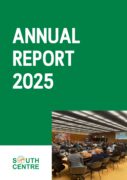
The South Centre carries out multiple activities to support developing countries with policy-oriented research, inputs and advice for negotiations and capacity building. The Report summarizes the South Centre’s activities in 2025 and highlights the contexts in which they were conducted as well as the objectives that were pursued with their implementation.
South Centre Inputs to the Intergovernmental Negotiating Committee on the UN Framework Convention on International Tax Cooperation
The Intergovernmental Negotiating Committee (INC) on the United Nations Framework Convention on International Tax Cooperation (UNFCITC) released three documents in January 2026 to inform negotiations at its Fourth Session, held in February 2026 in New York:
Co-Leads’ Concept Note (23 Jan 2026) prepared by Workstream III, presenting potential design features for dispute prevention and resolution protocol mechanisms.
The South Centre submitted inputs on the three documents on February 26 and March 6, 2026, following a call for input by the INC. The submissions are reproduced below:
OECD Two Pillar Solution: Designed to Prevent the Offshoring of High Tech Production to the Global South
By Abdul Muheet Chowdhary
The Organisation for Economic Co-operation and Development (OECD) Two Pillar solution is a tool of the developed countries designed to: a) prevent Multinational Enterprises (MNEs) in frontier technologies like clean energy, computing, semiconductors, etc. from offshoring production to developing countries, and b) minimize Global North MNEs’ taxable profits in developing countries. The recent exemption of the United States’ MNEs from certain aspects of the OECD Global Minimum Tax further strengthens these objectives. South Centre Member States and other developing countries should resist pressures to adopt the Two Pillar solution and make informed, evidence-based decisions, while considering the benefits of other simpler and more beneficial alternatives.
Taxation of digital services – A Domestic Law Solution for Overcoming Tax Treaty Barriers
By Radhakishan Rawal
Tax treaty treatment of source taxation of cross-border services continues to be an unresolved issue even fifteen years after it was recognized as a major issue within the Base Erosion and Profit Shifting (BEPS) Project. While the Organisation for Economic Co-operation and Development (OECD) Inclusive Framework’s Amount A of Pillar One does not seem to be getting finalised, at the United Nations (UN) an Intergovernmental Negotiating Committee (INC) is working on a UN Framework Convention on International Tax Cooperation which will offer a solution to the issue. The success of the UN’s initiative will depend on how many developed countries sign the Framework Convention and relevant Protocols.
This article evaluates a Domestic Law Solution to the issue which was presented at the February 2026 session of INC at New York. As per this solution, the domestic law of the source country can define the term “profits of an enterprise” to exclude consideration for digital services and thus bypass treaty restrictions on source taxation. As a result of this, the source country will be able to levy tax on such income in terms of Article 21(3) of the tax treaties signed by it provided the wording of Article 21(3) is identical to that in the UN Model Tax Convention.
The South Centre has made a submission to the Intergovernmental Negotiating Committee of the United Nations Framework Convention on International Tax Cooperation on the draft Framework Convention’s commitments, and Dispute Prevention and Resolution protocol.
The contribution addresses the priorities and perspectives of developing countries in promoting inclusiveness, fair allocation of taxing rights, stronger transparency standards, and effective and accessible dispute prevention and resolution mechanisms.
South Centre Inputs on 2025-2029 Work Program of the UN Tax Committee
25 September 2025
The United Nations (UN) Secretary-General appointed a new Membership of the UN Tax Committee to hold office from 2025-2029. This includes Members nominated by Brazil, Cambodia, Dominican Republic, India, Jamaica, Liberia, Nigeria and Sierra Leone (all of them are members States of the South Centre). The Committee will hold its first meeting in October in Geneva, Switzerland, and will decide, among other things, the issues they should work on during the tenure of the new members. The Committee also issued a call for inputs to stakeholders to help shape this agenda.
To ensure that the four-year agenda contains topics of importance to South Centre Member States and developing countries more generally, the South Centre made a submission to the Committee which is reproduced below.