The WTO TRIPS Waiver Should Help Build Vaccine Manufacturing Capacity in Africa
By Faizel Ismail
The current global health crisis created by the COVID-19 pandemic has re-focused our attention on the inadequacy of the TRIPS agreement and the patent system to address global public health crises. This time, developing countries must ensure that the TRIPS waiver succeeds in creating the impetus for the building of manufacturing capacity in the poorest countries, especially in Africa, for vaccines, pharmaceuticals and other health technologies. This is the only effective way in which African countries can reduce their dependence on imports of essential medicines and build their health security, contributing to the achievement of the sustainable development goals, for the poorest countries.
Interpreting the Flexibilities Under the TRIPS Agreement
By Carlos M. Correa
While the TRIPS Agreement provides for minimum standards of protection of intellectual property, it leaves a certain degree of policy space for WTO members, whether developed or developing countries, to implement the Agreement’s provisions in different manners, to legislate in areas not subject to the minimum standards under the Agreement, and to develop legal interpretations of such provisions to determine the scope and content of the applicable obligations. This paper focuses on some aspects of how panels and the Appellate Body of the WTO have interpreted said provisions. The paper also draws general conclusions for the implementation of TRIPS flexibilities, which are of crucial importance for the design of a pro-competitive intellectual property system and, in particular, for achieving public health objectives, as specifically recognized by the Doha Declaration on TRIPS and Public Health.
TRIPS Flexibilities and TRIPS-plus Provisions in the RCEP Chapter on Intellectual Property: How Much Policy Space is Retained?
By Vitor Henrique Pinto Ido
The Regional Comprehensive Economic Partnership (RCEP) was signed on 15 November 2020 by 15 Asian-Pacific countries (ASEAN—Brunei Darussalam, Cambodia, Indonesia, Laos, Malaysia, Myanmar, Philippines, Singapore, Thailand, and Vietnam—, and China, Japan, South Korea, Australia and New Zealand), comprising about one third of the world’s population and economy. India was a crucial party to the negotiations but opted out of the agreement. Ratification of the agreement is still pending, subject to more Parties ratifying it at the national level. This paper provides a broad overview of the RCEP agreement and discusses the details of the intellectual property (IP) Chapter. Significantly, it does not contain substantive TRIPS-plus provisions that undermine public health in developing countries—although it does contain such provisions in other areas such as copyrights, trademarks, and IP enforcement.
The Role of Courts in Implementing TRIPS Flexibilities: Brazilian Supreme Court Rules Automatic Patent Term Extensions Unconstitutional
By Vitor Henrique Pinto Ido
This policy brief provides a background, summary and analysis of the Brazilian Federal Supreme Court decision of 6 May 2021 that ruled automatic patent term extensions unconstitutional, striking down Article 40, Sole Paragraph, of the Brazilian Industrial Property Code of 1996. It concludes that this is a landmark ruling that contributes to the implementation of a more balanced patent regime in Brazil, with a positive impact on access to medicines in the country. It is an important precedent in relation to the role that courts may play in defining the contours of intellectual property protection and the TRIPS flexibilities.
Propiedad intelectual y acceso a medicamentos: una introducción a cuestiones clave – algunos términos y conceptos básicos
Por Germán Velásquez
La propiedad intelectual y las patentes en particular se han convertido en uno de los temas más debatidos sobre el acceso a los medicamentos, desde la creación de la Organización Mundial del Comercio (OMC) y la entrada en vigor del Acuerdo sobre los Aspectos de los Derechos de Propiedad Intelectual relacionados con el Comercio (ADPIC). Las patentes no son de ninguna manera las únicas barreras para el acceso a medicamentos que salvan vidas, pero pueden desempeñar un papel significativo, o incluso determinante. Durante el período de protección de la patente, la capacidad del titular de la patente para determinar los precios, en ausencia de competencia, puede hacer que el medicamento resulte inalcanzable para la mayoría de las personas que viven en los países en desarrollo. Este primer número de los “Materiales de capacitación del South Centre” pretende, en su primera parte, ofrecer una introducción a cuestiones clave en el ámbito del acceso a los medicamentos y la propiedad intelectual. La segunda parte describe y define algunos términos y conceptos básicos de esta área relativamente nueva de las políticas farmacéuticas, que son los aspectos comerciales de los derechos de propiedad intelectual que regulan la investigación, el desarrollo y el suministro de medicamentos y las tecnologías sanitarias en general.
Expanding the production of COVID-19 vaccines to reach developing countries
Lift the barriers to fight the pandemic in the Global South
By Carlos M. Correa
The unfolding of COVID-19 has shown that the international system has been unable to ensure equal access to the vaccines and other products necessary to fight the pandemic. While the need for a strong response remains obvious, proposals for scaling up the production of COVID-19 vaccines across the globe are still blocked in the World Trade Organization.
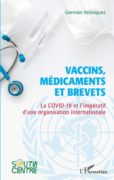
La covid-19 et l’impératif d’une organisation internationale
Details:
À partir de début 2020, le monde a dû faire face à un considérable défi sanitaire, économique et social avec l’épidémie de la COVID-19. La crise s’est poursuivie et aggravée dans la plupart des pays du monde. Beaucoup ont voulu explorer des réponses sans prendre réellement en compte les avis des principaux organismes internationaux dans le domaine de la santé, au premier rang desquels l’Organisation mondiale de la santé (OMS). L’OMS fait l’objet de critiques. Il est néanmoins fondamental qu’une agence multilatérale comme elle puisse exercer une véritable autorité et jouer un rôle de chef de le indépendant et en défense de l’ensemble des pays de la planète. Alors, comment faire pour qu’elle puisse jouer ce rôle ? Ce livre contribue à apporter des réponses à cette question, en s’appuyant sur les réflexions développées par le Centre Sud, un organisme intergouvernemental qui défend les perspectives des pays du Sud. Il aborde notamment l’avancement des réflexions et débats concernant l’accès aux médicaments et vaccins pour répondre à cette pandémie ou à d’éventuelles crises ultérieures.
Auteur: Germán Velásquez est conseiller spécial en matière de politique et de santé au South Centre à Genève.
Misappropriation of Genetic Resources and Associated Traditional Knowledge: Challenges Posed by Intellectual Property and Genetic Sequence Information
By Nirmalya Syam and Thamara Romero
Improper acquisition of genetic resources (GRs) and associated traditional knowledge (TK) without prior informed consent and on mutually agreed terms, in accordance with national laws of the country providing the GR and associated TK, as well as without any fair and equitable sharing of the benefits derived from their utilization, has been a significant concern for developing countries. Intellectual property (IP) rights can serve as one of the means of such misappropriation. One of the mechanisms sought by developing countries to prevent it consists in the establishment of an effective multilateral legal mechanism for defensive protection against misappropriation, primarily through the introduction of a mandatory disclosure requirement about the source and country of origin of such resources in intellectual property right (IPR) applications. These negotiations have been taking place in different fora. However, there is an increased sense of frustration due to the lack of progress in achieving consensus during the last twenty years. Meanwhile, new modes of misappropriation of GRs are evolving through the use of genetic sequence information and data of GRs, and by applying technological developments in synthetic biology. This paper discusses the use of IP and genetic sequence information and data as modes of misappropriation of GRs and associated TK and the deficits of the current international legal framework in preventing such misappropriation. This paper also maps the state of play of the ongoing negotiations in the context of these issues in different fora, and, in conclusion, proposes possible alternative approaches for addressing these pressing issues at the multilateral level.
Compulsory license in Germany: Analysis of a landmark judicial decision
By Christoph Spennemann and Clara Warriner
This policy brief analyzes how the German Federal Court of Justice addressed compulsory licensing under German patent law, where the request for a compulsory license was used in preliminary proceedings as a defense against alleged patent infringement.
Scope of Compulsory License and Government Use of Patented Medicines in the Context of the COVID-19 Pandemic
To meet public health needs, such as in the current COVID-19 emergency, governments can use compulsory licenses and government use as a tool for procurement and import of patented medicines.
These mechanisms are provided for in most laws worldwide. The WTO TRIPS Agreement, as reaffirmed by the Doha Declaration on TRIPS and Public Health, recognises the right of WTO members to grant compulsory licenses and their freedom to determine the grounds upon which such licenses may be granted (read our Call for Action on Intellectual Property and Trade Measures to Address the Covid-19 Crisis here).
The South Centre offers a guide for the issuance of compulsory licenses and government use, see here, aquí en español.
The table below provides information of instances of their use.
Scope of Compulsory License and Government Use of Patented Medicines in the Context of the COVID-19 Pandemic
To meet public health needs, such as in the current COVID-19 emergency, governments can use compulsory licenses and government use as a tool for procurement and import of patented medicines.
These mechanisms are provided for in most laws worldwide. The WTO TRIPS Agreement, as reaffirmed by the Doha Declaration on TRIPS and Public Health, recognises the right of WTO members to grant compulsory licenses and their freedom to determine the grounds upon which such licenses may be granted (read our Call for Action on Intellectual Property and Trade Measures to Address the Covid-19 Crisis here).
The South Centre offers a guide for the issuance of compulsory licenses and government use, see here, aquí en español.
The table below provides information of instances of their use.




 Details: